
Lesson 1 - "You Can Fly!"
Notes from a classroom where altitude meets gravity

I’ve shared pieces of my journey from aerospace engineering to teaching, but I haven’t yet brought you into the heart of this work, the classroom itself. This is where my transformation meets the young people of Pontiac, where the stories they inherit and the histories I’ve lived intertwine.
This isn’t just about teaching aviation. It’s about what it means to offer the possibility of flight in a world that hasn’t always granted that possibility equally.
Lesson 1 – “You Can Fly”
When I tell a group of Pontiac High School students that “You Can Fly!”, I do it with a lump in my throat. It’s not because I don’t believe it’s possible. I believe it more fiercely than I ever believed in rockets or automation. But I’ve walked long enough in this world to know that a phrase like that lands differently depending on the ground you’re standing on.
These kids, sharp, skeptical, stunningly creative, have inherited skies full of turbulence. They exist in systems built to surveil more than support. Their history is taught in fragments, or not at all. Dreams are sometimes too expensive or elusive to imagine. When we talk about aviation, we’re not just introducing them to engines and airspace, we’re asking what it means to lift off when your runway has been neglected for generations.
So this lesson is about more than career exposure. It’s a space to ask different questions. What does flight mean to you if no one in your family has ever been on a plane, or the closest you’ve come to an aircraft is when they fly over your apartment? What stories of access and exclusion have we inherited with our wings? What does it mean to learn about airspace in a place where mobility has always been constrained?
In my classroom, I built in something called a Flight Log, a space for students to reflect, sketch, name the contradictions they’re sitting with.
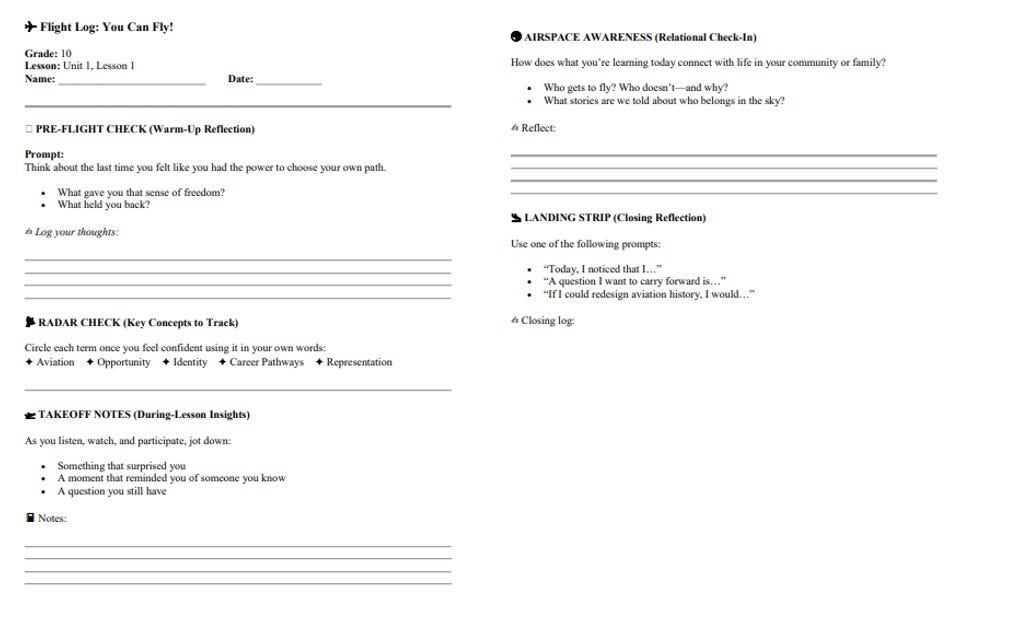
It’s a small thing, but it’s a signal that they have a safe space where they can share what’s on their mind. That their stories belong here. That even in a curriculum built for altitude, we’re going to make room for gravity.
Teaching isn’t a neat or neutral profession. It’s slow, tangled, and more honest than anything I ever did in a boardroom. But every time a student looks up from the lesson and asks a better question than the one I wrote, I remember why I left the launch pads behind.
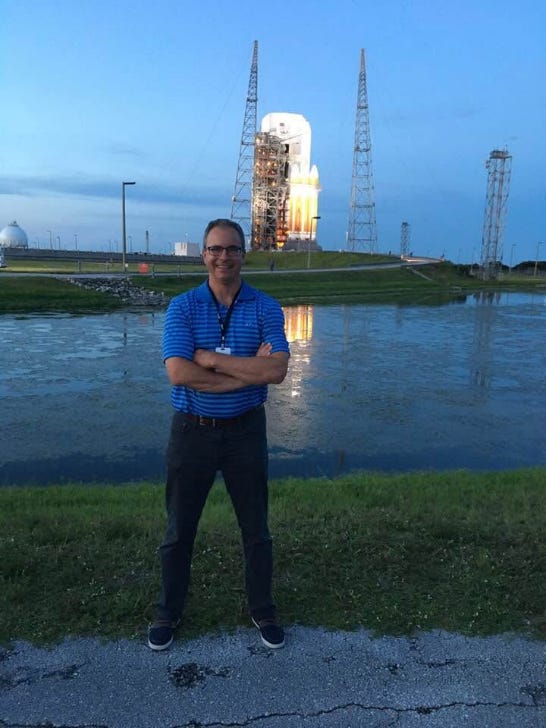
We’re not just reimagining curriculum, we’re rewiring what we mean when we say “You Can Fly”. It’s not just a slogan or tag line. It’s a mission, a purpose, maybe even a reckoning. It’s a beginning for them, and for me.
Closing invitation:
If this resonates, if you’ve ever wondered how stories of possibility land in communities where the odds are stacked differently, I invite you to follow along.
There’s no perfect way to teach or learn in these times, but maybe that’s the point. Maybe we learn together what it means to fly, even when the runway isn’t smooth.
Teaching isn’t a neat or neutral profession. It’s slow, tangled, and more honest than anything I ever did in a boardroom. But every time a student looks up from the lesson and asks a better question than the one I wrote, I remember why I left the launch pads behind.
Ray, as a retired teacher and in recognition of the youth whose lives touched mine, thank you. The four walls of my classroom were where we felt safe, got to know one another, and began to realize our own selves…even as we discussed the tension between the culture we lived in and the reality we desired.
Thanks for creating a safe container in your class for these kids to reflect, Ray. Those logs somehow remind me of ServiceSpace pod prompts :)